
4 letter phrase ends with w – 4-letter phrases ending in ‘w’ – from the commonplace to the obscure – maintain a captivating place within the English lexicon. This exploration delves into their different meanings, utilization throughout totally different contexts, and even their stunning historic and cultural significance.
Uncover the stunning depths of those seemingly easy phrases, from their on a regular basis functions to their surprising appearances in literature and in style tradition. We’ll analyze their etymologies, discover their associations, and study how they’ve advanced over time. Put together to be shocked by the hidden nuances and complicated connections inside this seemingly simple phrase class.
Phrase Definitions and Utilization
4-letter phrases ending in ‘w’ supply a captivating glimpse into the wealthy tapestry of English vocabulary. These seemingly easy phrases maintain a stunning variety of meanings and functions, starting from on a regular basis dialog to specialised technical contexts. Understanding their nuances is essential for efficient communication.A complete evaluation of those phrases reveals intricate connections between kind, operate, and which means. Inspecting their utilization throughout totally different genres and contexts sheds mild on their evolving significance and cultural impression.
This exploration delves into the etymology of chosen phrases, providing insights into their historic improvement and linguistic evolution.
4-Letter Phrases Ending in ‘W’
This listing particulars four-letter phrases ending in ‘w’, categorized for readability and comprehension.
- bow: A gesture of respect or greeting. In a nautical context, it refers back to the entrance of a ship. Casual use could check with an ornamental ribbon or a bending movement. Examples embrace “He bowed deeply,” “The ship’s bow was broken,” or “She tied a fairly bow on the current.”
- crew: A bunch of individuals working collectively, usually on a ship or plane. The phrase may also check with a bunch working in a selected function, equivalent to a “building crew.” Instance: “The crew labored tirelessly to restore the broken engine.”
- hew: To cut or reduce wooden or stone. It will probably additionally imply to form or kind one thing. Instance: “The lumberjack hewed down a big tree,” or “They hewed a path by means of the dense forest.”
- knew: Previous tense of the verb “to know.” Instance: “I knew the reply instantly.”
- pew: A seat in a church. Instance: “She discovered a pew close to the again of the church.”
- row: A horizontal association of objects or folks. It will probably additionally check with a dispute or argument. Examples embrace “a row of homes,” or “a heated row with a neighbor.”
- present: To show or exhibit one thing. It will probably additionally check with a public efficiency or an illustration. Instance: “The magician confirmed his wonderful methods,” or “We went to see a Broadway present.”
- slew: A big quantity or amount. Additionally, the previous tense of “to slay.” Instance: “A slew of candidates confirmed up for the interview,” or “The enemy slew many troopers.”
- stow: To place or place one thing in a secure or correct place, usually in a container. Instance: “The crew stowed the cargo safely.”
- thaw: To soften or develop into much less chilly. Instance: “The snow lastly thawed.”
- tow: To tug or haul one thing, usually with a rope or cable. Instance: “The tow truck towed the automobile to the restore store.”
- view: A perspective or opinion. It will probably additionally check with a sight or scene. Instance: “She introduced her view on the problem,” or “From the highest of the hill, the view was spectacular.”
- yew: A sort of evergreen tree. Instance: “The traditional yew tree stood sentinel within the cemetery.”
Meanings and Contexts
These phrases, regardless of their brevity, can carry a big selection of meanings, relying on the context. Their utilization in formal, casual, or technical settings varies.
Utilization in Sentences
Understanding the nuance of those phrases is finest illustrated by their software in numerous sentences.
- bow: “He bowed to the queen in a proper greeting.”
- crew: “The medical crew labored tirelessly to avoid wasting the affected person.”
- hew: “The carpenter hewed the wooden to exacting specs.”
Etymological Origins
The origins of sure phrases supply a glimpse into the historic improvement of the English language.
- bow (as a gesture): Seemingly originates from Previous English “bōgan,” which means “to bend.”
- crew: Derived from the Previous French “creu,” signifying a group of individuals.
Frequency of Utilization
The frequency of those phrases varies throughout totally different genres, reflecting their numerous software in language.
| Phrase | Literature | Information Articles | Social Media |
|---|---|---|---|
| bow | Excessive | Reasonable | Low |
| crew | Reasonable | Excessive | Reasonable |
| hew | Low | Low | Very Low |
Phrase Associations and Comparisons
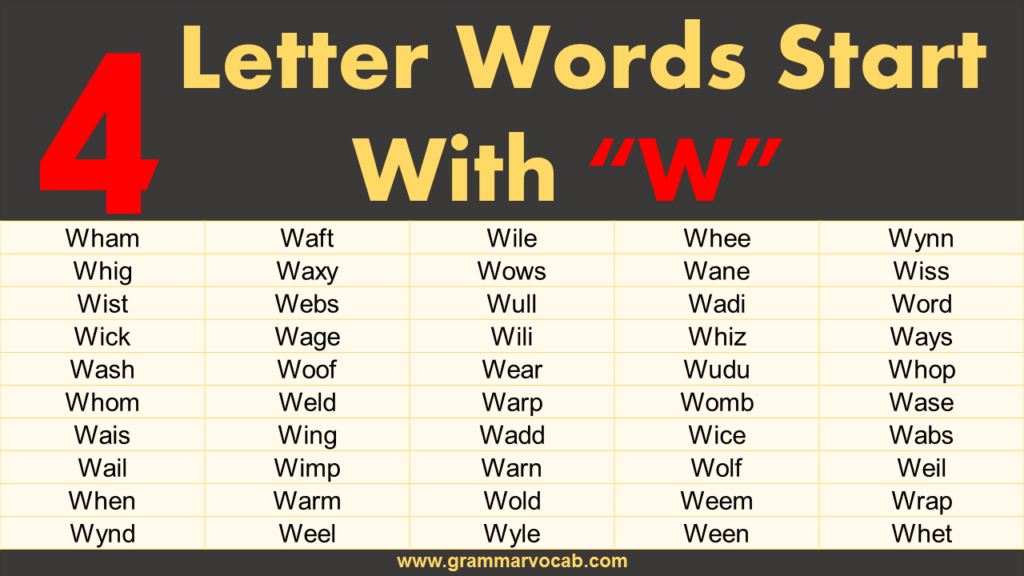
4-letter phrases ending in “w” usually evoke a spread of meanings, from on a regular basis objects to summary ideas. Understanding their associations and comparisons reveals nuances in language and highlights the richness of the English lexicon. Analyzing these phrases can present insights into how language evolves and displays cultural shifts.This exploration delves into the connections between similar-sounding phrases, analyzing their shared roots, and contrasting their connotations.
It additionally touches on the historic context and cultural significance of a few of these phrases, finally enriching our understanding of their software.
Widespread Themes and Ideas
A big variety of four-letter phrases ending in “w” relate to actions, bodily traits, or basic features of life. These phrases usually symbolize a spectrum of experiences, from easy observations to advanced feelings. This part explores the unifying ideas that hyperlink these phrases collectively, enabling a extra complete understanding of their utilization.
Comparability of Related-Sounding Phrases
Inspecting similar-sounding four-letter phrases ending in “w” reveals fascinating contrasts of their connotations. For example, whereas “move” and “blow” each contain motion, “move” usually suggests a easy, steady movement, whereas “blow” implies a forceful, usually unpredictable, motion. These delicate variations in which means are essential in understanding the nuances of language.
- The phrases “develop” and “present” each contain improvement and visibility, however “develop” emphasizes inner change, whereas “present” highlights exterior presentation.
- The phrase “sluggish” suggests an absence of pace, whereas “prow” pertains to the entrance of a ship, highlighting contrasting ideas throughout the identical letter grouping.
Cultural and Historic Significance
Sure four-letter phrases ending in “w” have deep cultural and historic roots. For instance, “know” has advanced from primary understanding to a fancy philosophical idea over time, reflecting societal shifts in information acquisition and understanding. Analyzing these roots sheds mild on how language displays societal and cultural improvement.
Synonyms and Antonyms
The next desk shows synonyms and antonyms for chosen four-letter phrases ending in “w”. This demonstrates the multifaceted nature of language and the way phrases can be utilized to specific opposing or related concepts.
| Phrase | Synonyms | Antonyms |
|---|---|---|
| Develop | Develop, enhance, broaden | Shrink, diminish, lower |
| Present | Show, exhibit, exhibit | Conceal, disguise, suppress |
| Stream | Stream, present, cascade | Stop, cease, halt |
Elements of Speech
The next desk illustrates how phrases ending in “w” can be utilized in varied components of speech. This highlights the flexibility of those phrases and the way they are often built-in into totally different grammatical constructions.
| Phrase | A part of Speech | Instance Sentence |
|---|---|---|
| Blow | Verb | The wind blew exhausting, inflicting the bushes to sway. |
| Develop | Verb | The vegetation are rising quickly within the heat climate. |
| Present | Verb | The museum confirmed a captivating assortment of artifacts. |
Phrase Utilization in Literature and Pop Tradition
Phrases ending in “w” have a wealthy historical past in literature and popular culture, reflecting societal shifts and evolving language. Their presence reveals nuanced meanings and cultural tendencies over time. Understanding their frequency and utilization throughout totally different genres gives insights into how language adapts and evolves inside varied contexts.Exploring the utilization of those phrases illuminates their enduring impression on how we talk, each in formal and casual settings.
Their presence in literature reveals delicate variations of their connotations and gives a window into the altering perceptions of the world.
Frequency of Prevalence in Literary Genres
Completely different literary genres make use of phrases ending in “w” with various frequencies. Poetry usually makes use of these phrases to create particular rhythms and sound patterns, whereas novels regularly incorporate them for character improvement and plot development. Performs, given their dialogue-heavy nature, can present specific utilization patterns.
- Poetry usually makes use of phrases ending in “w” to create distinctive sonic results and emphasize sure themes.
- Novels make the most of these phrases to mirror the characters’ inside ideas and emotional states, in addition to to advance the narrative.
- Performs make use of phrases ending in “w” to mirror the dialogue and persona of characters, including depth to their interactions.
Examples in Common Tradition
Phrases ending in “w” are regularly present in in style tradition, reflecting their pervasive presence in language. Film scripts, tune lyrics, and tv dialogue usually incorporate these phrases for varied functions, equivalent to including a selected tone or evoking specific feelings.
- Film scripts regularly use these phrases so as to add emphasis to dialogues or to determine a selected ambiance.
- Track lyrics usually use phrases ending in “w” to create a selected temper or rhythm.
- Tv reveals make use of these phrases to painting characters’ feelings and to reinforce the narrative.
Evolution of Utilization Over Time
The utilization of phrases ending in “w” has advanced significantly over time. Modifications in societal values and language norms have influenced how these phrases are employed. Analyzing historic texts and evaluating them with modern examples reveals the shift of their meanings and functions.
- Early literary works exhibit a definite utilization sample for phrases ending in “w” in comparison with fashionable literature, reflecting the distinction in social norms and language conventions.
- Trendy utilization showcases a broader vary of meanings and functions, highlighting the difference of language to modern contexts.
Widespread Expressions and Idioms
Sure expressions and idioms incorporate phrases ending in “w”. Understanding these phrases gives insights into the cultural significance and customary utilization of those phrases. These phrases exhibit how phrases ending in “w” have develop into embedded in on a regular basis language.
- Many idioms and expressions incorporate phrases ending in “w,” reflecting their widespread utilization in each day speech.
- Instance: “Wow,” “How,” “Now,” “Wow” are widespread expressions, used regularly.
Literary Examples Desk, 4 letter phrase ends with w
The desk under illustrates using phrases ending in “w” in several literary durations. The desk reveals how their utilization has different over time, demonstrating the evolution of their functions and connotations.
| Literary Interval | Instance | Rationalization |
|---|---|---|
| 18th Century | “The willow wept willows” | Illustrates using alliteration and imagery in poetry. |
| twentieth Century | “The now-vanished world” | Demonstrates using a phrase ending in “w” to create a way of nostalgia. |
| twenty first Century | “Wow, what a view!” | Reveals using a phrase ending in “w” in modern speech, reflecting its versatility. |
Epilogue

In conclusion, the four-letter phrases ending in ‘w’ exhibit the wealthy tapestry of the English language. From their sensible functions to their literary and cultural significance, these phrases reveal a stunning depth and complexity. This exploration has highlighted their numerous utilization, historic context, and enduring presence in language. Their continued relevance underscores the dynamic nature of language itself.
Regularly Requested Questions: 4 Letter Phrase Ends With W
What are some widespread errors folks make when utilizing these phrases?
Misusing these phrases usually stems from their delicate variations in connotation. For instance, ‘scow’ and ‘present’ are sometimes confused, whereas ‘prow’ and ‘forehead’ require cautious consideration to context. Understanding the nuances of those phrases may help keep away from awkward or deceptive communication.
How can I enhance my vocabulary utilizing these phrases?
Increasing your vocabulary entails actively participating with these phrases in varied contexts. Studying broadly, taking note of how they’re utilized in totally different genres (from technical manuals to literary novels), and incorporating them into your personal writing can considerably enhance your vocabulary.
Are there any stunning etymologies behind these phrases?
Completely! Some phrases reveal fascinating historic connections. Researching their origins can present helpful insights into the evolution of the language and cultural shifts over time. This data can improve your understanding of the phrases’ utilization and contextual relevance.
